Guides · Updated June 13, 2026
The Salt-Air Survival Guide for Beach Sub-Zeros
The ocean pays the view. The ocean also sends the repair bills. This is how you keep more of the first and less of the second.
Salt air kills beach Sub-Zeros through the condenser and the door gaskets. Within a thousand feet of surf in 32233 or 32266, clean the coil quarterly instead of yearly and expect gaskets to last three to four years, not ten. Add surge protection before storm season. Those three habits prevent most four-figure repairs.
For Sub-Zero repair in Atlantic Beach or Neptune Beach, call (904) 650-0561 or book online.
What salt fog actually does to a refrigerator
Stand on the dune walkover at Beach Avenue early on a summer morning and you can taste the mechanism. Microscopic salt particles ride the onshore breeze, drift through every vent grille in town, and settle wherever air slows down. Inside a Sub-Zero®, air slows down at exactly one place: the condenser coil.
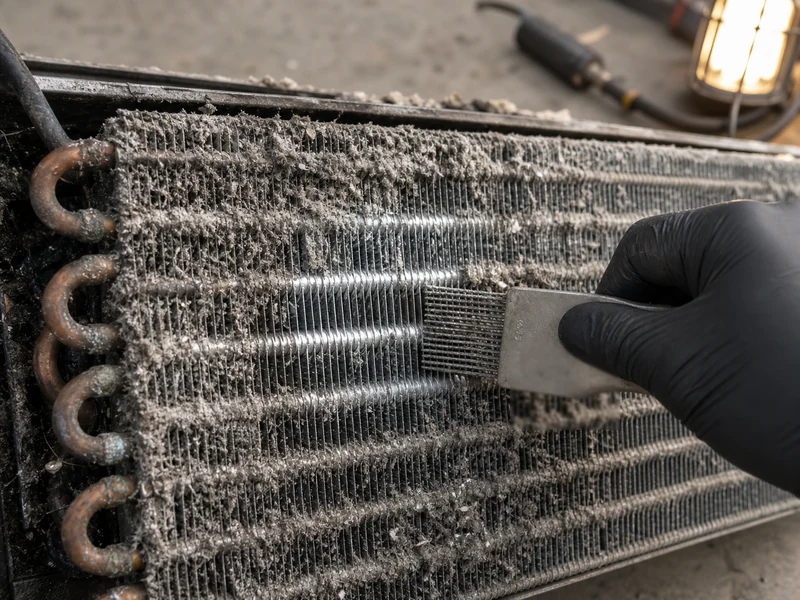
Salt is hygroscopic — it pulls moisture out of the air — so the deposit never really dries. Damp salt bonds with household dust into a felt blanket over the fins, then starts electrochemical corrosion on the aluminum itself. Heat rejection drops. The compressor compensates by running longer, drawing more current, wearing faster. On BI-series units the control board eventually notices the marathon and posts an EC50 code; on older units the first sign is a unit that simply stops making cold.
Door gaskets fight a parallel war. Heat, ultraviolet light, and salt-heavy humidity harden the vinyl until the seal stops hugging the cabinet — and the moisture that sneaks past shows up as condensation on and around the doors long before anything else complains.
Match the maintenance schedule to your distance from the surf
Sub-Zero's official guidance — clean the condenser every six to twelve months — was written for the average American kitchen. The beach compresses that timeline. Use your address, not the manual.
| Where the unit lives | Coil cleaning | Gasket life |
|---|---|---|
| Within 1,000 ft of the dunes (Beach Ave, Ocean Blvd, Ocean Front St) | Quarterly | ~3 years |
| Beach side of Mayport Rd (Old Atlantic Beach, Selva Marina, most of 32266) | Twice a year | 3–4 years |
| West of the Intracoastal | Every 6–12 months | 5+ years |
| Outdoor or summer kitchen, any distance | Quarterly, no exceptions | 2–3 years |
How to check your own condenser for salt crust
Fifteen minutes, no special tools, and you will know exactly which row of that table you live in. This is the one piece of Sub-Zero maintenance we genuinely encourage owners to do between professional visits.
- Cut power first. Switch the unit off at the control panel or the breaker. Fans do not care about your fingers.
- Open the top grille. On most built-ins it tilts up without tools and exposes the condenser.
- Light the fins at an angle. A flashlight beam across the coil face reveals what a straight-on look hides: gray felt or a white crystalline crust means salt has moved in.
- Brush and vacuum gently, with the fins. Soft brush, light passes, vacuum the fallout. A bent fin blocks airflow forever, so no enthusiasm.
- Escalate what will not brush off. Stubborn crust or green-white corrosion bloom calls for a professional cleaning — photograph it, mention it when you book, and we arrive with the right gear.
Gaskets: the three-to-four-year reality
Nobody budgets for door seals, and at the beach everybody should. The test costs nothing: close the door on a dollar bill and pull. Real drag means the seal still works; a bill that slides free means conditioned air is leaking out and August is leaking in. Run the test at the top corners especially — beach gaskets fail there first, where sun and door-swing stress meet.
A leaking seal is never just a seal. The compressor runs longer to replace the lost cold, frost builds where humid air meets the evaporator, and the energy bill quietly climbs. A professionally fitted gasket lands in the $550-to-$1,100 lane and resets the clock; the compressor it protects costs two to four times that. We check seals on every visit regardless of what we came for, because at this latitude they are a wear item — same as brake pads.
Storm season: the surge after the outage is the killer
Northeast Florida is the lightning capital of the country — more than a hundred thunderstorm days a year — and our recent storm ledger reads Matthew, Irma, Dorian, Ian, Nicole. Outages are routine. What most owners do not know is that the dangerous moment is not when the power dies; it is when it comes back. Restoration spikes can run 50 to 100 percent over nominal voltage for an instant, and that instant is what executes control boards.
The signature afterward is unmistakable: interior lights work, control panel dead. BI-series units are the most frequent victims, and the board replacement runs $550 to $1,100. The defense costs less: a whole-home surge protector at the panel runs roughly $900 to $1,200 installed, protects every appliance in the house, and pays for itself the first time the grid hiccups. Have an electrician fit one before June; thank yourself by September.
Beach facts on record
The numbers this guide rests on, stated plainly so you can hold us to them.
The factory interval vs. the beach interval
Sub-Zero recommends condenser cleaning every 6 to 12 months. Within roughly 1,000 feet of surf, we recommend — and follow — a quarterly schedule.
Gasket life at the ocean
Door gaskets within a few blocks of the dune line last 3 to 4 years before sealing degrades, versus roughly a decade inland.
The set points that matter
38°F in the refrigerator, 0°F in the freezer, and a full 24 hours to stabilize after any major repair before temperatures mean anything.
Surge math
Whole-home surge protection runs about $900 to $1,200 installed. The control board it most often saves costs $550 to $1,100 — per strike.
The cost of waiting
Most salt-driven repairs caught early land between $250 and $1,100. Let corrosion reach the sealed system and the work runs $1,500 to $3,000.
The beach Sub-Zero calendar, season by season
Salt, humidity, and storms each have a season at this latitude, and so should the maintenance that answers them. Tape this to the inside of a cabinet door.
| Season | What the coast is doing | What to do |
|---|---|---|
| Spring (Mar–May) | Onshore breezes pick up salt load | Deep coil clean; fit a whole-home surge protector before storm season |
| Early summer (Jun–Jul) | Dew points climb, lightning season opens | Bill-test every gasket; swap water filters; confirm surge protection |
| Late summer / fall (Aug–Oct) | Peak humidity, hurricane and nor'easter risk | Coil clean again near the dune; after any outage, give units 24 hours and check for a dark panel |
| Winter (Nov–Feb) | Drier air, lower load | Second filter swap; inspect drain pans and door alignment while the system is relaxed |
Oceanfront addresses on Beach Avenue, Ocean Boulevard, and Ocean Front Street collapse the spring and late-summer coil cleans into a quarterly rhythm — the schedule the refrigerator service page assumes when it talks about salt-driven failures.
A worked example: the cost of skipping the calendar
Numbers make the case better than warnings do. Take one BI-36U a few blocks off the dune and run two owners side by side over a decade.
| Line item | Owner who runs the calendar | Owner who waits for failure |
|---|---|---|
| Coil cleanings | Quarterly, ~$300/yr in service | None until an EC50 stops the unit |
| Gaskets | One planned swap, $550–$1,100 | Replaced only after frost and sweat set in |
| Surge protection | $900–$1,200 once, whole house | None — board killed by a restoration surge |
| Big-ticket repairs | Rare; failures caught early | Control board $550–$1,100, then a strained compressor $1,000–$2,000 |
| Ten-year outlook | Unit still running, food never lost | Repeated emergencies, replacement on the table |
The maintained owner spends predictably and keeps the unit past twenty years; the other pays in spoiled groceries, emergency premiums, and a sealed-system job that early cleaning would have prevented. When a neglected unit finally lands warm, it starts on our not-cooling triage page — and the BI-series page covers the board that the skipped surge protector would have saved.
Straight answers
Salt-air questions from beach owners
How far from the ocean does the quarterly cleaning rule reach?
Roughly a thousand feet from the dune line — in practice, everything east of East Coast Drive and the oceanfront blocks of 32266. That zone takes daily salt fog. Between there and Mayport Road, twice a year is sensible. West of the Intracoastal you can follow the standard factory interval. When in doubt, open the grille and look: the coil will tell you which zone you live in.
Does a stainless door corrode faster than a panel-ready front?
The door skin is rarely the problem either way — quality stainless tea-stains long before it fails. The corrosion that matters happens where you cannot see it: condenser fins, fasteners, electrical spades, and drain pans behind the grille. A panel-ready unit hides in cabinetry but breathes the same salt air through the same vents. Judge a beach unit by its coil, not its face.
Should I shut the Sub-Zero down before a hurricane evacuation?
If a long outage looks likely, empty what will spoil, leave the unit running, and put it on the best surge path you have. Do not unplug a full unit and leave — a sealed warm box grows mold impressively fast in Florida. After power returns, give it 24 hours to stabilize before judging temperatures. Lights on but a dead panel afterward means the restoration surge found the board.
Is blocking the grille to keep salt air out ever a good idea?
No — that trades a slow problem for a fast one. The condenser needs every bit of airflow the grille provides; choke it and the compressor overheats within weeks, which is exactly the failure you were trying to prevent. The right defense is removal, not restriction: clean the salt off the fins on schedule instead of trying to keep it from arriving.
Should an oceanfront unit get a different filter or coil treatment than an inland one?
Same parts, tighter schedule. There is no special salt-proof condenser or filter for Beach Avenue — Sub-Zero builds one coil. What changes is cadence: quarterly coil cleaning within a thousand feet of surf instead of yearly, and six-month water filters against 14-to-28-grain JEA water instead of twelve. The hardware is standard; the calendar is what keeps a beach unit alive past twenty years.
Does running a dehumidifier in the kitchen actually help my Sub-Zero?
At the margins, yes — for the gaskets and condensation, not the coil. Lower room humidity means less moisture for a tired seal to leak in and less load on the mullion heater, so doors sweat less and gaskets stretch a little further. It does nothing for salt on the condenser, which arrives on the air whether the room is damp or dry. Treat a dehumidifier as gasket insurance, and keep cleaning the coil on schedule.
Sub-Zero Atlantic Beach fixes what salt air breaks across Atlantic Beach 32233 and Neptune Beach 32266 — call (904) 650-0561 or use the online scheduling page to put a coil cleaning or gasket check on the calendar.