Repairs
Sub-Zero Door Gasket Replacement at the Beach
The cheapest part on the unit, and the one salt air kills first. Replace it before it takes the compressor with it.
Sub-Zero Atlantic Beach replaces door gaskets on Sub-Zero built-in and classic units throughout Atlantic Beach 32233 and Neptune Beach 32266. Salt fog and humidity harden a beach seal in three to four years, so the door stops grabbing the cabinet. Call (904) 650-0561 or book online; most gasket jobs run $550 to $1,100.
For Sub-Zero repair in Atlantic Beach or Neptune Beach, call (904) 650-0561 or book online.
Updated June 13, 2026 — written by the techs who run these beach routes.
Why a beach gasket dies young
A Sub-Zero® door gasket is a magnetic extrusion — a precise rubber profile with a steel strip inside that pulls the door tight against the cabinet face. It is engineered for eight to ten years. Here it gets three or four.
Salt fog rolls off the surf and settles on everything within a few blocks of the dune line. It dries out the rubber, pits the magnet, and the seal goes from supple to chalky. Once it stops grabbing, warm wet air walks straight into the box. The unit answers the only way it can: longer run times, more frost, a colder dial that fixes nothing.
You feel it before you see it. The door swings a hair too easily, the gasket squeaks when you open it, and condensation starts beading on the front. That is the moment to call, not after the evaporator ices over and the freezer side starts frosting up.
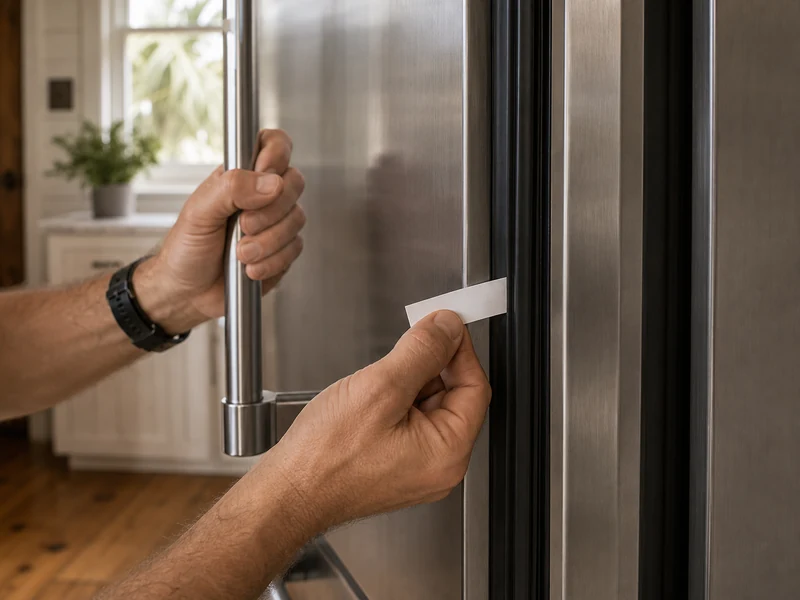
What the seal is doing, and what it costs
Gaskets fail in a few familiar ways, and the symptom usually tells us how far the damage has spread before we ever open the door.
| What the door is doing | Where we look first | Cost lane |
|---|---|---|
| Dollar bill slides out with no drag | Magnet strip and seal compression | $550–$1,100 |
| Condensation beading on the door face | Gasket seal, then the perimeter heater | $550–$1,100 |
| Chalky, cracked, or flattened rubber | Replace the gasket kit, both doors if paired | $550–$1,100 |
| Door drifts open on its own | Hinge cartridge and door alignment | $550–$1,100 |
| Frost returning fast after a defrost | Seal leak letting humid air into the box | $550–$1,100 |
| Compressor now running nonstop | Heat load from a long-failed seal | $1,000–$2,000 |
House rule worth knowing: we will not sell you a compressor because a gasket was the real culprit. The seal gets checked and corrected first, and only then do we judge whether the bigger components took damage.
How a gasket swap goes
Most of these are a single, clean visit. The order does not change.
- Confirm the seal is the problem. Bill test around all four sides, a finger check for cracks and flat spots, and a look at the door face for sweat. We rule out the heater circuit before condemning the rubber.
- Match the OEM kit to your serial. Sub-Zero door profiles changed across generations; a BI-36U seal is not a 650 seal. The right kit comes off the van when you gave us the model number, or gets ordered against the tag when you did not.
- Fit it in place. Old gasket out, channel cleaned, new seal seated evenly so the magnet pulls flat with no gaps at the corners. The cottage alcoves leave no room to roll the unit, so the work happens right where it lives.
- Check the hinges and prove the seal. A door that sags will defeat a perfect gasket, so hinges get adjusted if needed. Then we close it on the bill again, corner to corner, and confirm a clean grab before we pack up.
Beach streets eat seals on a schedule
The addresses on Beach Avenue and Ocean Boulevard sit closer to open surf than anything else in Duval County, and their gaskets show it first — we have replaced seals on three-year-old units a block off the dune that already failed the bill test on every side. The rebuilt streets around Selva Marina and the Country Club run mostly BI-series built-ins installed after 2014, and those doors are now hitting the beach replacement window right on time.
Educational diagnostic scenario
A BI-48S two blocks off Ocean Boulevard: doors sweating all summer, owner cranking the dial colder with no help. Gasket was chalky and flat along the hinge side; magnet had lost most of its grab. Both door seals replaced, hinges tweaked, dial returned to 38°F. Sweat gone, run time dropped, no frost on the next defrost. A four-year-old seal that salt air had already retired.
Hold one number in mind: the box should sit at 38°F up top and 0°F in the freezer. If your only fix has been turning the dial down, the seal — not the thermostat — is usually what failed. When the sweat is on a glass wine door instead, the cause is often humidity rather than the gasket, and the maintenance rhythm in our salt-air survival guide is what keeps the next seal alive longer.
What a gasket replacement actually includes
A seal swap is more than peeling off rubber. The price covers a short list of work that decides whether the new gasket lasts its full beach span or fails early.
- OEM gasket kit matched to your serial. Sub-Zero door profiles changed across generations; a BI-36U cross-section is not a 650 cross-section, and a generic stick-on will not magnetically seat a built-in.
- Channel cleaned and inspected. The retainer channel collects salt grit and old adhesive that keep a new seal from sitting flat. It gets cleared before the new rubber goes in.
- Even seating, corner to corner. The magnet has to pull flat with no gaps at the corners — a gasket fitted loose at one corner sweats there within a month.
- Hinge check and door alignment. A sagging door defeats a perfect seal, so the hinge cartridge gets adjusted if the door is dropping.
- Perimeter heater verified. On units with an anti-sweat heater circuit, we confirm it is working so the new seal is not blamed for condensation that is really a dead heater.
- Bill-test proof before we leave. The door closes on a dollar bill on all four sides and has to grab with drag everywhere.
How long a beach gasket lasts by location
Distance from the surf is the single biggest factor in seal life here. The closer to the dune line, the shorter the clock — these are the windows we actually see on this stretch of Duval coast.
| Location | Typical gasket life | Why |
|---|---|---|
| Beach Avenue / Ocean Boulevard oceanfront | 3–4 years | Heaviest salt fog in Duval, constant humidity |
| Selva Marina / a few blocks inland | 4–6 years | Salt still reaches it, slightly diluted |
| West of East Coast Drive | 6–8 years | Far enough back that humidity, not salt, leads |
| Climate-controlled, sealed interior | 8–10 years | Near the inland Sub-Zero design figure |
The takeaway: if you live within sight of the water, budget a seal roughly twice as often as the manual implies, and put a yearly bill test on the calendar. The maintenance habits that stretch every one of these windows are in our salt-air survival guide, and a tired seal is the most common root cause behind the freezer frost we get called for.
Which seal your model actually needs
Sub-Zero changed door profiles across generations, so the kit is model- and door-specific. A generic stick-on will not magnetically seat a built-in no matter how it looks on the shelf. Here is how the common beach units sort out.
| Model family | Door count to seal | Kit notes |
|---|---|---|
| BI-36U / BI-36UG over-under | One fresh-food, one freezer drawer | Single-door profile; not a UFD part |
| BI-36UFD french door | Two narrow fresh-food, one drawer | UFD-specific kit and hinge hardware |
| BI-42SD / BI-48S side-by-side | Two full-height doors | Distinct fridge and freezer profiles, replace as a pair |
| 600-series 632 / 650 / 661 | One or two, by configuration | Ordered to serial; revisions differ within a model |
| Wine cabinet (424, IW, BW) | One glass or solid door | Lighter profile; pairs with the door heater check |
We pull the model and serial off the tag inside the fresh-food door before ordering, the same discipline the BI-series page and the 600-series page spell out for boards and parts. The right kit on the first trip is the difference between a one-visit fix and a second appointment.
The failure chain a tired seal sets off
A gasket is the cheapest part on the unit and the one that drags the most expensive ones down with it. Caught early it is a $550-to-$1,100 fix; ignored, it climbs a predictable ladder.
| Stage | What you notice | Cost to stop it here |
|---|---|---|
| 1. Seal aged out | Door swings easy, bill slides free, faint sweat | $550–$1,100 gasket |
| 2. Humidity in the box | Condensation on the face, frost creeping back | Still just the gasket |
| 3. Evaporator icing | Frost choking airflow, weak cold | Gasket plus a defrost check |
| 4. Compressor overrun | EC50 code, unit running nonstop | $1,000–$2,000 if the compressor strained |
The ladder is why we check seals on every visit regardless of what we came for — at this latitude a gasket is a wear item like brake pads. The early warning usually shows up first as condensation on and around the doors, and the maintenance rhythm that resets the clock is in our salt-air survival guide.
Quick answers
Gasket questions we hear on every block
How long does a Sub-Zero gasket really last at the beach?
Three to four years within a few blocks of the surf, against the eight to ten a Sub-Zero seal manages inland. Salt fog and year-round humidity harden the rubber and chew the magnet strip, so the seal stops grabbing the cabinet. Most owners replace twice as often here, and the ones who do not pay for it in compressor run time.
How do I test whether my door gasket has quit?
Two checks. Shut a dollar bill in the door and tug — if it slides out without drag, the seal is loose there. Then run a finger around the gasket for cracks, flat spots, or a chalky bloom. Condensation beading on the door face or frost creeping back inside the box are the same story told louder.
Can you fit gaskets in a tight Old Atlantic Beach alcove?
That is the normal job here. The 1940s-to-70s cottages bury 700-pound built-ins in alcoves with barely an inch of side clearance, and almost every gasket swap happens in place — door open, old seal off, new one fitted, hinges checked. We rarely roll a unit out for a gasket, and when we must, it goes on skates over floor protection, not muscle.
Do you use genuine Sub-Zero gasket kits?
Yes — OEM seals matched to your exact model and door, never generic stick-on profiles. A Sub-Zero gasket is a precise magnetic extrusion; the wrong cross-section will not seal a built-in no matter how it looks on the shelf. Give us the model and serial off the tag inside the fresh-food door when you book and the right kit rides out on the first trip.
Is a new gasket cheaper than living with a leaky one?
Far cheaper. A failed seal lets warm, wet beach air pour into the box, so the compressor runs longer to hold temperature and ices the evaporator on the way. Left alone, a $550 to $1,100 gasket job turns into defrost-heater work, then a strained compressor at $1,000 to $2,000. The seal is the cheapest insurance on the unit.
Should I replace both door gaskets on a side-by-side at once?
Usually yes, when both seals are the same age. On a BI-42SD or a 632 side-by-side the two doors share the same salt and humidity history, so a seal that failed the bill test on one side is rarely far behind on the other. Doing both in one visit saves a second trip charge and matches the door alignment. We will tell you honestly if one is still grabbing fine and can wait.
Can I soften a stiff gasket instead of replacing it?
It buys a little time, not a fix. Warming a hardened seal with a hair dryer and working petroleum-free silicone into the hinge fold can restore some grab for a few weeks. But salt fog has already pitted the magnet strip and dried the rubber from the inside, and no conditioner reverses that on this coast. Treat it as a stopgap until the replacement, not a substitute for it.
How can a bad gasket throw an EC50 code on my Sub-Zero?
A torn or hardened seal lets warm beach air leak into the box continuously, so the refrigerator side never stops working to hold temperature. That endless run time is exactly what an EC50 flags — excessive compressor run on the fresh-food side. Owners often assume the worst and price a compressor; nine times out of ten near the dune the real culprit is the seal or a salt-clogged coil, which is why we check both before quoting anything big.
Are freezer-side gaskets and refrigerator-side gaskets different parts?
Yes, even on the same unit. The freezer door seal works against a colder, drier compartment and a heavier frost load, so its profile and the heater behind it differ from the fresh-food seal. On a BI-42SD or a 632 side-by-side that means two distinct kits, each matched to its door and serial. We confirm which doors are leaking before ordering, because fitting a fresh-food profile to a freezer door is exactly how a seal fails again in a season.
How long does a gasket replacement take on a beach built-in?
Most are a single visit of an hour or two. The seal comes off, the retainer channel gets cleaned of salt grit and old adhesive, the OEM kit is seated corner to corner, and the hinges are checked so a sagging door does not defeat fresh rubber. In the tight Old Atlantic Beach alcoves the work happens in place — no rolling the 700-pound unit out. We prove the seal on a dollar bill on all four sides before packing up.