Repairs
Sub-Zero Ice Maker Repair in Atlantic Beach
Clear cubes are a small miracle on water this hard. We make the miracle repeatable.
Sub-Zero Atlantic Beach repairs Sub-Zero ice makers in Atlantic Beach 32233 and Neptune Beach 32266. The usual killer is the water itself — JEA supply runs 14 to 28 grains per gallon, hard enough to choke a fill valve with scale. Call (904) 650-0561 or schedule online; most ice maker repairs run $250 to $550.
For Sub-Zero repair in Atlantic Beach or Neptune Beach, call (904) 650-0561 or book online.
Hard water does most of the damage
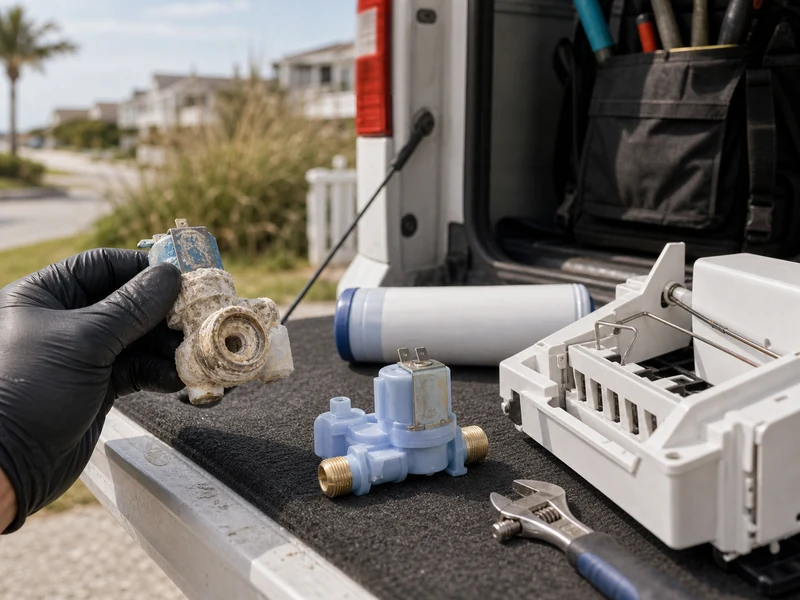
Our water rises through limestone, and it brings the limestone along. At 14 to 28 grains per gallon, every fill cycle deposits minerals on the inlet valve screen, inside the fill tube, and through the filter. Nothing breaks loudly. The valve just meters a little less water each month.
Less water means smaller cubes, then hollow cubes, then a maker that cycles without producing anything. By the time the bin is empty, the scale has had a year’s head start. If yours has already gone quiet, run the no-ice triage sequence before booking — it rules out the freebies.
Salt air piles on for outdoor units. Cottage patios and summer kitchens near the dune put undercounter ice machines in the spray zone, where scale works the inside and corrosion works the outside. Both problems have schedules that beat them — that is the whole point of our guide to keeping appliances alive at the beach.
What the ice is telling you
Read the bin before you call. It narrows the diagnosis more than most owners expect.
| What the bin looks like | First check on our list | Typical lane |
|---|---|---|
| Cubes shrinking or hollow | Fill volume and scale-choked inlet valve | $250–$550 |
| No ice at all, unit cooling fine | Valve solenoid, then the maker module | $250–$550 |
| Ice tastes like the refrigerator smells | Filter age and bin housekeeping | $250–$550 |
| Water trickling under the unit | Split fill tube or frozen fill path | $250–$550 |
| 600-series maker dead, service light on | Solenoid fault — energized past 15 seconds | $550–$1,100 |
| UC-15I slowing down, cloudy sheets | Scale across the water system, drain flow | $250–$550 |
How an ice maker visit runs
- Measure the fill. We trigger a cycle and measure actual water volume against spec. Low fill is the hard-water signature, and it points upstream, not at the maker.
- Test the valve electrically. Clean voltage and correct coil resistance get verified before any part takes the blame.
- Descale or replace. Scale gets cleared from the screen and fill path; a valve that no longer meters right gets swapped for OEM.
- Fresh filter, always. A rebuilt water path fed by a spent cartridge is a repeat call waiting to happen.
- Prove two harvests. We watch full cycles and check cube size and clarity before the van leaves the street.
From Selva Marina to the Town Center
The Country Club rebuild filled the streets around Selva Marina with BI-generation built-ins after 2014, and their water inlet valves are now hitting the wear window right on schedule. The cottage blocks closer to the ocean run older equipment with its own quirks, plus undercounter ice machines serving porches and patios. One town south, the story repeats — coverage details live on the Neptune Beach page.
Educational diagnostic scenario
A BI-42SD a block off Selva Marina Drive: cubes shrank for a year, then production stopped entirely. Fill test measured half of spec. Valve screen was white with scale, solenoid still healthy. Descale, new OEM valve, fresh filter — full bin within 24 hours. Total ticket landed mid-lane. The year of shrinking cubes was the warning nobody billed for.
Pattern-level notes for those streets — housing stock, water, the works — are on the Selva Marina ice maker page. And when cubes fail because the whole box is running warm, the real fix starts with refrigerator-side diagnosis instead.
What moves an ice-maker quote up or down
Two scaled-up makers on the same street can land in different lanes. These are the factors that decide where yours sits before we ever open the panel.
| Factor | Cheaper lane | Pricier lane |
|---|---|---|
| How far scale has spread | Screen and fill path only — descale | Pitted solenoid seat — new valve |
| Maker type | Modular grid maker in the freezer | UC-15I clear-ice machine — more system |
| Filter history | Recently changed, supply protected | Years on one cartridge, valve already eaten |
| Drain style on undercounter units | Gravity drain, clear run | Pump drain or retrofit plumbing fault |
| Generation | BI fill valve, parts on the van | 600-series module, ordered to serial |
| Salt exposure | Indoor kitchen unit | Patio or summer-kitchen unit, corroded too |
The single biggest swing is the filter. A cartridge changed every six months on this water keeps the valve out of the expensive lane for years; one left in for three years usually drags the whole job up with it.
When to try it yourself, and when to call
A few ice-maker fixes are genuinely homeowner work on this hard water. Past those, the math tips toward a tech who measures fill volume instead of guessing.
Worth a ten-minute try first
Change the filter if it has been more than six months — that alone restores some scaled makers. Confirm the ice-maker arm or switch is actually on; it gets bumped during bin cleanings. Empty and wash the bin if the only complaint is taste. The full no-tools sequence lives on our no-ice triage page.
Call when the numbers are off
If a fresh filter does not bring cube size back, the fill valve is metering low and needs to be tested electrically and measured against spec — not parts-cannoned. A 600-series maker with the service light flashing, a UC-15I slowing into cloudy sheets, or water trickling under the unit all want a meter and gauges. Those are the calls where a flat diagnosis saves you buying the wrong part twice.
How hard water hits each ice maker we service
The same 14-to-28-grain water finds a different weak point on each generation. Knowing which maker you own narrows the part before we load the van.
| Ice maker | Where the scale lands first | Typical fix |
|---|---|---|
| BI-series grid maker (2008–2022) | Water inlet valve screen and solenoid | Descale or new valve, $250–$550 |
| 600-series module maker (1996–2009) | Solenoid and module; fault past 15 sec | Module to serial, $550–$1,100 |
| UC-15I undercounter ice machine | Cold plate and water system run continuously | Scheduled descale; drain check, $250–$700 |
| Integrated column maker | Fill path and version-specific filter | Valve and filter to serial, $250–$650 |
The UC-15I takes the worst of it because it runs water continuously over a cold plate to make clear restaurant-style ice — more contact, more scale. The BI-series page covers the built-in valve in depth, and the 600-series page the module-side faults on the older classics.
The maintenance rhythm that keeps the bin full
Ice makers on this water reward a calendar more than any other part of a Sub-Zero. Run this and the valve stays out of the expensive lane for years.
- Filter every six months. Not the twelve the manual assumes — our supply is near the top of the Florida scale. Mark the install date on the housing so the swap is never a guess.
- Descale when production thins. Shrinking or hollow cubes are the early warning. A food-safe descale at that stage clears the fill path before scale reaches the valve seat.
- Quarterly clean for outdoor and UC-15I units. Patio machines near the dune take salt outside and scale inside; a rinse and condenser brush slow both.
- Replace the valve before it strands you. Once a fresh filter no longer brings cube size back, the valve is metering low and wants testing — not another season of decline.
The full habit list for every appliance at the beach lives in our salt-air survival guide.
Quick answers
Ice questions we field all summer
Why does Atlantic Beach water chew through ice makers?
JEA water comes out of the limestone Floridan aquifer at 14 to 28 grains per gallon — very hard by any standard. Every gallon leaves minerals behind, and they collect exactly where ice makers are fussiest: the inlet valve screen, the fill tube, the filter. The valve slowly strangles, fill volume drops, cubes shrink, and one day the bin is just empty.
How often should a Sub-Zero water filter change near the beach?
On water this hard, every six months — set a reminder and treat it like an oil change. A spent filter does two bad things at once: it stops protecting the valve from scale and it starts seasoning your ice with whatever it has collected. Six-dollar-a-bag gas station ice is the only alternative, and nobody buys a Sub-Zero to live that way.
Do you service the UC-15I undercounter ice machine?
Yes — it is the one Sub-Zero ice machine still in production since 2009, and the local failure mode is always the same: scale. The UC-15I makes clear restaurant-style ice by running water continuously over a cold plate, which means hard water hits it harder than any other unit in the house. Descaling on a schedule keeps it honest; we also sort out gravity-versus-pump drain issues on retrofit installs.
Is descaling worth it, or should the ice maker be replaced?
Depends what the scale has already eaten. If the valve still meters correctly after cleaning and fill volume comes back to spec, descaling plus a fresh filter — the $250 to $550 lane — buys years. If the valve solenoid is pitted or the module is failing, a new assembly pushes toward $550 to $1,100. We price both paths on the same visit and you pick.
How long after a repair before a Sub-Zero ice maker fills the bin again?
A healthy harvest cycle runs roughly every 90 minutes to two hours, so a fully cycling maker refills a bin within about 24 hours. We never leave on a promise — we watch at least two complete harvests and check cube size and clarity before the van moves. If yours just got a fresh valve and filter, give it a full day before judging the volume; the first cubes off scaled-out hardware are always the weakest.
Why does my ice smell or taste like the freezer?
Ice is a sponge. Cubes sitting in the bin absorb whatever air is in the compartment, and a spent filter on this hard water stops scrubbing the supply, so both ends of the problem hit at once. Toss the old batch, change the filter, and wipe the bin. If the off-taste survives a fresh filter and a clean bin, the supply line or a stagnant fill tube is next on our list.
Can salt air corrode an outdoor or summer-kitchen ice machine?
Yes, and faster than owners expect on Beach Avenue and the oceanfront blocks. A UC-15I or undercounter unit on a patio fights scale on the inside and salt on the outside at the same time — corroded condenser fins, pitted fasteners, and a compressor working overtime to reject heat through a coated coil. A rinse-and-clean on the quarterly rhythm from our salt-air guide is the cheap defense.
Is a whole-house water softener worth it just to protect the ice maker?
It helps the whole house, not only the maker — and on 14-to-28-grain JEA water that is a real argument. A softener drops the mineral load reaching every fill valve, filter, and the UC-15I, stretching all of them. The caveat: very soft water tastes flat to some and needs its own upkeep. For most beach homes, six-month filters plus periodic descaling protect the ice maker for far less. We will give you the straight trade-off, not a sales pitch.
How can I tell whether it is the ice maker or the water dispenser that failed?
They share a supply but split downstream. If the in-door water dispenser still runs but the bin stays empty, the supply line and main inlet valve are fine and the fault is in the maker — its module, solenoid, or fill tube. If both the dispenser and the maker are dry, the trouble is upstream: a closed saddle valve, a scaled main inlet valve, or a spent filter choking flow. Testing the dispenser first narrows the visit before we arrive.