Repairs
Sub-Zero Refrigerator Repair in Atlantic Beach
A built-in that cost more than your first car deserves better than guesswork. Diagnosis first, written number second, wrench third.
Sub-Zero Atlantic Beach repairs Sub-Zero refrigerators throughout Atlantic Beach 32233 and Neptune Beach 32266 — independent, diagnosis-first, with a written flat quote before any panel comes off. Call (904) 650-0561 or book through the online scheduler. Most refrigerator work lands between $250 and $1,100; sealed-system jobs run $1,500 to $3,000.
For Sub-Zero repair in Atlantic Beach or Neptune Beach, call (904) 650-0561 or book online.
Written and checked by the techs who run these routes — June 13, 2026.
What you get when you call the beach line
A tech answers, not a script. We will ask for the model and serial off the tag inside the door, because a 650 from 1999 and a BI-36UFD from 2015 fail in completely different ways, and the right parts should ride out on the first trip.
On site, the order never changes. We test before we touch: airflow across the condenser, voltage at the board, temperatures at the coil. Then you get one written number. Approve it and we work; decline it and you owe the diagnostic, nothing more.
Before we leave, the unit has to prove itself — 38°F in the refrigerator, 0°F in the freezer. After compressor or sealed-system jobs we will also tell you the unglamorous truth: a Sub-Zero® needs a full day to settle before you judge it.
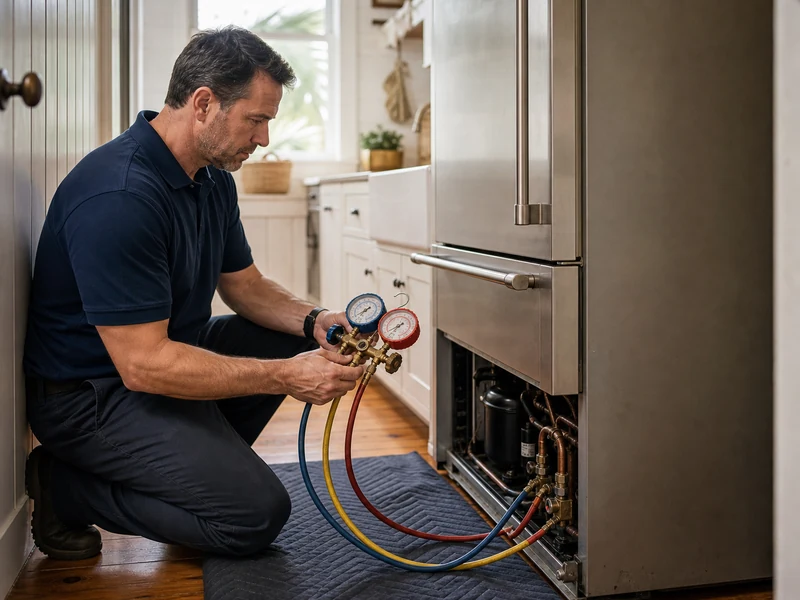
Symptom, first check, cost lane
Refrigerators fail in patterns, not riddles. Here is how the common ones map out at beach prices.
| What the fridge is doing | Where we look first | Cost lane |
|---|---|---|
| Running nonstop, EC50 on the panel | Condenser coil behind the top grille | $250–$550 |
| Fresh-food side warm, freezer happy | Evaporator fan motor | $250–$550 |
| Interior lights fine, display dark | Control board and surge history | $550–$1,100 |
| Doors sweating, lettuce wilting early | Door gaskets and heater circuit | $550–$1,100 |
| Hot to the touch, both sides warm | Compressor and start components | $1,000–$2,000 |
| Cooling fading over weeks, not days | Sealed-system pressure test | $1,500–$3,000 |
One house rule worth knowing: nobody here quotes a compressor or sealed-system job until airflow, electrical, and pressure readings all point the same direction. Big tickets require proof, not hunches.
Why refrigerators work harder on this stretch of coast
Between the dune walkovers and Sherry Drive, salt rides the air year-round. It drifts through the toe grille, glues itself to dust on the condenser fins, and quietly steals the coil’s ability to shed heat. The compressor makes up the difference with longer run times — until it can’t. Close to the ocean we put coil cleaning on a quarterly rhythm, not the six-to-twelve-month schedule the manual assumes.
The housing stock sets the rest of the table. Old Atlantic Beach cottages tuck their units into alcoves that strangle airflow, while the rebuilt streets around Selva Marina and the Country Club run on BI-series built-ins installed after 2014 — now squarely inside the board-and-ice-maker failure window. Different streets, different failures, same van.
Humidity gets its own line item. A seal that has gone soft lets damp sea air pour into the box, and the unit pays in frost, sweat, and run time. If your door fails the paper test, start with a proper gasket replacement — and put the habits from our salt-air survival guide on the calendar before the next failure picks a date for you.
Classics, sealed systems, and honest math
Plenty of kitchens here still run 500 and 600-series units from the 1990s, and their known weakness is refrigerant leaks at the evaporator. The giveaway is a frost stripe covering just the first few inches of coil where a healthy one wears an even white coat. That is sealed-system territory — recovery, brazing, vacuum, recharge — and it is exactly the work worth pricing before passing sentence on the unit.
The math usually lands on repair. We have seen evaporator-and-heat-exchanger jobs on thirty-year-old classics come in around $2,500, against replacement quotes starting near $14,000 once cabinetry enters the conversation. If your display is talking in symptoms instead of dashes, run the checks on our not-cooling triage page first; if the unit is a 1996–2009 survivor, the 600-series page covers its particular habits.
Parts we replace most on beach refrigerators
The salt, the humidity, and the lightning each have a favorite component. These are the parts that come off this coast’s Sub-Zero refrigerators most often, why they fail here specifically, and which generation they sit in.
| Part | Why it fails on this coast | Where it lives |
|---|---|---|
| Condenser fan motor | Salt-bound dust loads the bearing; the motor drags then stalls | BI and 600-series, behind the toe grille |
| Evaporator fan motor | Wears with run hours a long-failed gasket piles on | Fresh-food evaporator housing |
| Control board | Restoration surge after a lightning-season outage | BI built-ins (brownout lock); 600-series EEPROM |
| Door gasket kit | Salt fog and humidity harden the rubber in 3–4 years | Every generation, both doors on paired units |
| Water inlet valve | 14–28 grain JEA water scales the screen and seat shut | BI and 600-series ice-maker feed |
| Condenser fan triac | Heat and voltage spikes cook the board-mounted switch | BI control board |
Gaskets, fan motors, thermistors, and inlet valves for BI and 600-series units ride the van by default. Boards are the exception — they get ordered against your serial, because Sub-Zero revised them through every run and a BI board or a 600-series board is generation-specific.
What to do before the van pulls up
None of this is required, but each step shortens the visit or saves the food while you wait.
- Read the model and serial. The tag sits inside the fresh-food door on the upper-left wall. Those two numbers decide which board revision and parts we load — it is the single biggest factor in a one-visit fix.
- Pull the toe grille and look at the coil. If the condenser is packed with grey salt-bound lint, a cleaning may be most of the cure on an EC50 or a unit running nonstop. No tools needed — the grille pops off by hand.
- Leave the set points alone. Cranking the dial colder masks a failing system and adds run time to a compressor already working overtime. Hold 38°F up top and 0°F below and tell us what it actually reads.
- Protect what is irreplaceable. If the box is warming, move medication and anything you cannot replace to a cooler. A closed Sub-Zero holds for hours; an open one does not.
Repair or replace: the honest math on a beach built-in
A built-in Sub-Zero is engineered for twenty-plus years, and replacing one is never just the appliance — flush cabinetry, a recut surround, and hinge recalibration stack thousands onto the sticker. Here is how the common calls actually pencil out before you decide.
| Situation | Repair cost | Verdict |
|---|---|---|
| Dead board, refrigeration sound | $550–$1,100 | Repair — the cabinet, not the board, is the expensive part |
| Evaporator fan or scaled ice valve | $250–$550 | Repair, no question |
| One sealed system leaking, 15-year unit | $1,500–$3,000 | Usually repair vs. a five-figure flush replacement |
| Both sealed systems failing at once | $3,000+ | Run the numbers — replacement starts to compete |
| Liner cracked, hinges salt-seized | varies | Replace — the carcass is the problem, not parts |
We have seen evaporator-and-heat-exchanger jobs on thirty-year classics land near $2,500 against replacement quotes starting around $14,000 once cabinetry enters it. The exception is a carcass salt has already eaten — and we will tell you which case you have, in writing. The BI-series page runs the same math for built-ins of the teardown era.
When it is genuinely DIY, and when it is not
A few refrigerator fixes are honest homeowner work. Past those, the math tips toward a tech with gauges rather than a parts cannon.
Worth a try before you book
Pull the toe grille and vacuum a salt-felted condenser — that alone clears many an EC50 or a unit running nonstop, and it needs no tools. Confirm the set points read 38°F up top and 0°F below; a houseguest changes those more than the factory does. After an outage, cut power for five minutes and restore it, then give the unit a few hours to see if a glitch clears.
Call when the meter has to come out
A warm box after the basics check out, a dark panel with the lights still on, a partial frost stripe on the evaporator, or a compressor that clicks and quits all want electrical and pressure readings — not guesswork. Those are the calls where a flat diagnosis saves you buying the wrong part twice, and they start with the triage on our not-cooling page.
Quick answers
Refrigerator repair questions, beach edition
Do you quote the price before starting refrigerator work?
Always. The visit starts with diagnosis, and the diagnosis ends with a written flat number. You approve it before a panel comes off, and the number does not creep while we work. No hourly meter, no surprise line items. If the math says the repair is not worth it, we say that too — in writing.
Is a fifteen-year-old Sub-Zero refrigerator worth repairing?
Usually, yes. These units are engineered for twenty-plus years, and even the deep end — sealed-system work at $1,500 to $3,000 — beats a five-figure replacement plus the carpentry to make a new box fit old cabinetry. The exception is a carcass the salt has already eaten: corroded hinges, rusted liners, doors that will not square up. We tell you which case you have.
Which refrigerator parts ride on the van by default?
Door gaskets, evaporator fan motors, thermistors, and water inlet valves for the BI and 600-series units that dominate this ZIP. Control boards get ordered against your serial number instead — Sub-Zero revised boards constantly, and guessing wrong wastes everyone’s week. Give us the model and serial off the tag inside the door when you call and the odds of a one-visit fix go way up.
Can you work on a built-in jammed into a tight cottage alcove?
That is most of our calendar. The 1940s-to-70s cottages in Old Atlantic Beach hide 700-pound built-ins in alcoves with an inch of clearance per side. Nearly every repair happens in place — grilles off, panels off, unit untouched. When one truly has to roll out, we use skates and floor protection, not enthusiasm. Heart-pine floors survive the visit.
How long can a Sub-Zero hold safe temperatures without power after an outage?
A full, closed Sub-Zero holds the fresh-food side under 40°F for roughly four hours and a packed freezer near 0°F for about 24 hours — keep the doors shut and it stretches. The bigger beach risk is not the food, it is the restoration surge when the lightning-season power slams back on, which is what scrambles a BI control board. Read the model and serial off the tag before you call so the right board rides out the first trip.
Does a BI refrigerator and freezer share one compressor or two?
Two. Every Classic Built-In runs dual refrigeration — separate sealed systems and compressors for the fresh-food and freezer sides — so one half can fail while the other holds temperature perfectly. That is why we ask which side is warm before quoting anything: a warm fridge with a cold freezer points at one system, not the whole unit. The 1990s 600-series classics share more hardware, so the same symptom there reads completely differently.
Why is there water pooling under my Sub-Zero on the kitchen floor?
Two common culprits. A clogged defrost drain lets meltwater overflow the evaporator pan and run out the bottom — routine on cottage units that have logged thousands of defrost cycles. The other is a split or scaled ice-maker fill line on this 14-to-28-grain JEA water. We trace the water to its source rather than just mopping; most pooling jobs land in the $250 to $550 lane once the path is clear.
My refrigerator clicks then goes quiet every few minutes — what is that?
A compressor trying to start and failing. The click is the start relay or overload protector cutting in; the silence is the compressor refusing to run, often because a hard-start component or the compressor itself is worn. On the beach a salt-choked condenser can push a marginal compressor over the edge by making it work too hard. We meter the start circuit before condemning the compressor — sometimes it is a $250-to-$550 relay, not a $1,000-to-$2,000 compressor.
Will you give a second opinion on another company’s sealed-system quote?
Gladly. Sealed-system work runs $1,500 to $3,000, so a second set of gauges before you commit is money well spent. We rerun the diagnosis from scratch — airflow, electrical, and pressure — and tell you plainly whether the leak is real, where it is, and whether the unit is worth the repair against its cabinetry. No pressure to book the job with us if the first quote was honest. Bring the paperwork and the model number.