Fix It
Why Has My Sub-Zero Ice Maker Stopped Making Ice?
At the beach, dead ice makers rarely die of old age. They drown in minerals first.
When a Sub-Zero ice maker quits in Atlantic Beach, hard water is the usual suspect — JEA water runs 14 to 28 grains per gallon, and scale chokes the fill valve and filter before anything else fails. Check the switch, the filter date, and the supply line. Most ice maker repairs run $250 to $700.
For Sub-Zero repair in Atlantic Beach or Neptune Beach, call (904) 650-0561 or book online.
Five checks before you pick up the phone
Each one takes a minute. One of them solves the problem for a surprising number of callers.
- Is the ice maker actually on? Sub-Zero units have a dedicated ice maker switch or a control-panel toggle, and cleaning crews flip them constantly. Confirm it before anything else.
- How old is the water filter? If you cannot remember changing it, it is overdue. A spent filter strangles flow and the mold freezes air instead of water.
- Is the supply valve open? Find the saddle or quarter-turn valve under the sink or behind the kickplate. Renovation plumbers close them and forget — common in remodeled cottage kitchens around here.
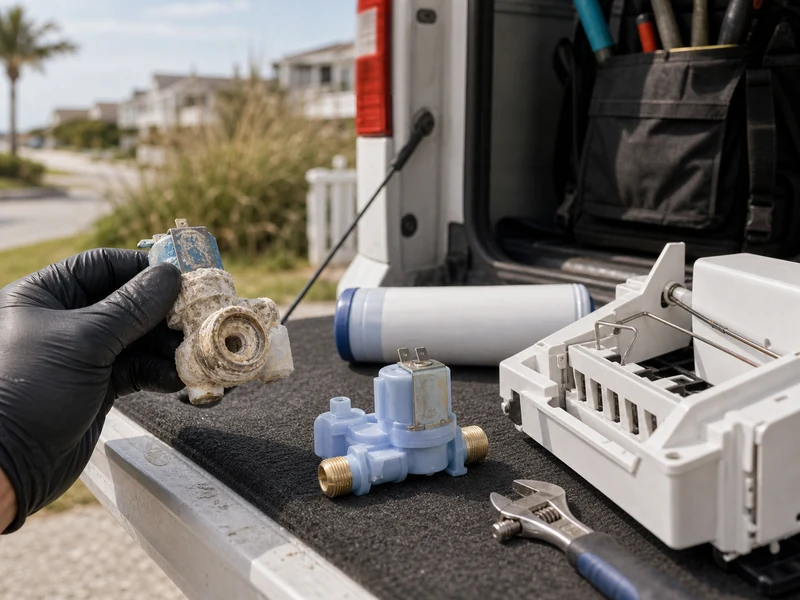
- Listen for the fill. Open the door, lift the bin, wait. A healthy cycle ends with a few seconds of water hiss. Buzzing with no water means the valve is energizing but scale has sealed it shut.
- Look for a frozen fill tube. A stalactite of ice where water enters the mold means a weak fill dribbled and froze. Thawing it helps for a week; the underlying flow problem stays.
What the ice is telling you
Ice makers fail in stages, and each stage points somewhere specific. Read the bin like a gauge.
| What you see in the bin | First check | Cost lane |
|---|---|---|
| Small, hollow, or cloudy cubes | Filter age, then valve screen | $250–$550 |
| Production slowed to a tray a day | Inlet valve flow under pressure | $250–$550 |
| No ice, but you hear the valve buzz | Scaled-shut water inlet valve | $250–$550 |
| No ice, no sound, panel normal | Solenoid circuit or module fault | $550–$1,100 |
| Ice tastes or smells off | Filter, then bin and mold cleaning | $250–$550 |
| Cubes fused into one glacier | Bin auger, harvest cycle, door seal | $250–$700 |
Hard water does most of the killing here
Jacksonville pulls its water from the limestone of the Floridan aquifer, and it shows: 14 to 28 grains per gallon, rated very hard, among the stiffest in the state. Every fill cycle pushes that mineral load through a valve orifice about the size of a pencil lead. Scale builds, flow drops, ice shrinks. Simple, slow, and relentless.
Salt air piles on at the margins. Outdoor and summer-kitchen ice machines near the dune line — and there are plenty between Beach Avenue and the Beaches Town Center — corrode at the fittings while they scale on the inside. Our salt-air survival guide covers that half of the problem.
The fix is rhythm: filters on a six-month cycle, a descale when production thins, and a new valve when the screen finally seals. All of it is routine work for our ice maker repair service, and none of it costs compressor money.
Model quirks the van is stocked for
Classic 600 series (1996–2009)
The cottages remodeled around 2000 still run these, and their boards watch the ice maker closely: a solenoid energized longer than fifteen seconds logs a fault and can light the service icon. Worn bail arms and tired mold heaters round out the list. One warning — 600-series parts went through dozens of revisions, and a 632 assembly does not promise to fit a 650.
BI series (2008–2022)
The default built-in of the teardown era, including most of the post-2014 Country Club homes. The water inlet valve solenoid is the consumable: ten years of hard-water duty and it sticks, buzzes, or seals shut. We see so much of it in one neighborhood that Selva Marina ice maker calls get their own page.
UC-15I undercounter ice machines
The patio favorite, and the most scale-sensitive machine Sub-Zero makes. Gravity-drain installs fare worse than pump-drain ones because standing mineral water evaporates in place. These need scheduled descaling the way boats need bottom paint — skip it and the bill grows.
What a tech does on arrival for a dead ice maker
An ice-maker diagnosis is mostly measurement, not guesswork. The order stays the same so the cheap fix gets ruled in before any part is named.
- Confirm the maker is on and fed. The dedicated switch or panel toggle gets verified, then the saddle valve — a closed supply is a no-cost fix that looks like a dead maker.
- Measure the fill volume against spec. A cycle is triggered and the actual water caught and measured. Low fill is the hard-water signature and points upstream at the valve, not the maker.
- Test the inlet valve electrically. Clean voltage at the solenoid and correct coil resistance get checked before the valve is condemned — a healthy valve with a scaled screen just needs descaling.
- Read the filter date and the line. An overdue cartridge on 14-to-28-grain water is replaced as standard, because a rebuilt water path fed by a spent filter is a repeat call.
- Prove two full harvests. The maker runs complete cycles and cube size, clarity, and bin delivery get confirmed before the van leaves the street.
Scaled valve or failed module? How to tell them apart
A scaled inlet valve and a failed ice-maker module both end in an empty bin, but they sit in different cost lanes — a valve descale or swap runs $250 to $550, a module fault $550 to $1,100. These tells separate them before we open anything.
| Clue | Points to a scaled inlet valve | Points to a module fault |
|---|---|---|
| Sound on the harvest cycle | Valve buzzes, no water hiss behind it | No motion or buzz at all from the maker |
| How it got here | Cubes shrank for months, then stopped | Worked fine, then quit abruptly |
| Filter and fill | Overdue filter, fill volume measures low | Filter recent, fill volume normal when forced |
| 600-series service light | Usually off — the water path is the issue | Solenoid energized past 15 seconds logs a fault |
| Cost lane | $250–$550 | $550–$1,100 |
On a BI-series built-in the valve is the usual wear part on this water; on a 600-series classic a flashing service light points at the module side. Either way the full visit and pricing live on our ice maker repair service page.
Straight answers
Ice maker questions, answered without the runaround
How often should I swap the water filter with 32233 water?
Every six months, not the twelve the manual implies. The filter spec assumes average municipal water; ours runs 14 to 28 grains per gallon, near the top of the Florida scale. A filter that quits flowing chokes ice production long before any warning light admits it. Cheap insurance — mark the calendar and stick to it.
Why are my Sub-Zero cubes small, cloudy, or hollow?
Starved water flow. The mold only freezes what the fill cycle delivers, and when scale narrows the inlet valve screen or an exhausted filter drops the pressure, each harvest gets a little thinner. Hollow or shrunken cubes are the early warning; no cubes at all is the late one. Catch it in the small-cube stage and the repair usually stays in the cheap lane.
Can I descale the ice maker myself with vinegar?
You can clean the bin and the visible mold surfaces, and it will not hurt anything. But the scale that actually stops ice lives inside the water inlet valve and its screen — parts you cannot reach with a jug of vinegar and good intentions. Once flow has dropped, the valve usually needs replacement rather than a rinse. That is a stocked-part visit, not a project weekend.
Is it smarter to replace the whole ice maker assembly?
Sometimes, and we will say so when it is. On a 600-series unit with a tired mold heater, a worn bail arm, and a scaled valve, one new assembly beats three separate service calls. On a BI-series unit where only the valve has failed, replacing the assembly is paying for parts that still work. The flat quote spells out both paths so you choose with real numbers.
The maker hums but no water comes in — bad valve or no supply?
A hum with no fill splits two ways. If you hear the inlet valve buzz on the harvest cycle but nothing hisses behind it, the solenoid is energizing into a scaled-shut screen — that is the 14-to-28-grain water sealing the valve, and a stocked-part swap. If there is no buzz at all, check the saddle valve under the sink first; renovation plumbers close them and forget, which is common in remodeled cottage kitchens here. One is a part, the other is a quarter-turn.
Why does the ice maker freeze into one solid block instead of separate cubes?
Usually a slow fill, a stuck harvest, or a tired bin auger. When hard-water scale drops the fill rate, cubes do not release cleanly and weld together in the bin; a worn auger then fails to keep them broken up. A hardened door gasket letting warm beach air in makes it worse by re-melting and re-freezing the surface. We check fill volume and the harvest cycle before blaming the auger, since a scaled valve upstream causes most of it.