Models
Sub-Zero 600 Series Repair at the Beach
The workhorse that still hums in cottages remodeled around 2000 — and the one that talks to you in double dashes when its memory gives out.
Sub-Zero Atlantic Beach repairs the 600 series classics — 632, 642, 650, 661 and their siblings — across Atlantic Beach 32233 and Neptune Beach 32266. The usual culprits are an EEPROM board showing double dashes, a drifting thermistor, or a stalled ice maker solenoid. Call (904) 650-0561 or book online; most 600-series work runs $250 to $1,100.
For Sub-Zero repair in Atlantic Beach or Neptune Beach, call (904) 650-0561 or book online.
Updated June 13, 2026 — notes from the techs who keep these classics alive.
What the 600 series is, and where it lives here
The 600 line ran from 1996 to 2009 and replaced the 500 series as Sub-Zero®’s built-in mainstay. Around the beaches it shows up in cottages remodeled near the turn of the century — kitchens redone before the teardown era swapped in BI units — and in plenty of houses where the owners simply refused to give up a unit that still works.
The roster: 632 and 642 side-by-sides, the 650 over-under, the 661 bottom-drawer, plus 611, 685, and 695 variants. The series spanned three electronic generations — call them 600-1, 600-2, and 600-3 — and the differences matter when parts get ordered.
These are sturdy machines. The refrigeration usually outlasts two control boards, which is why the smart play is fixing the electronics and gaskets as they age rather than replacing a perfectly good sealed system wrapped in irreplaceable cabinetry.
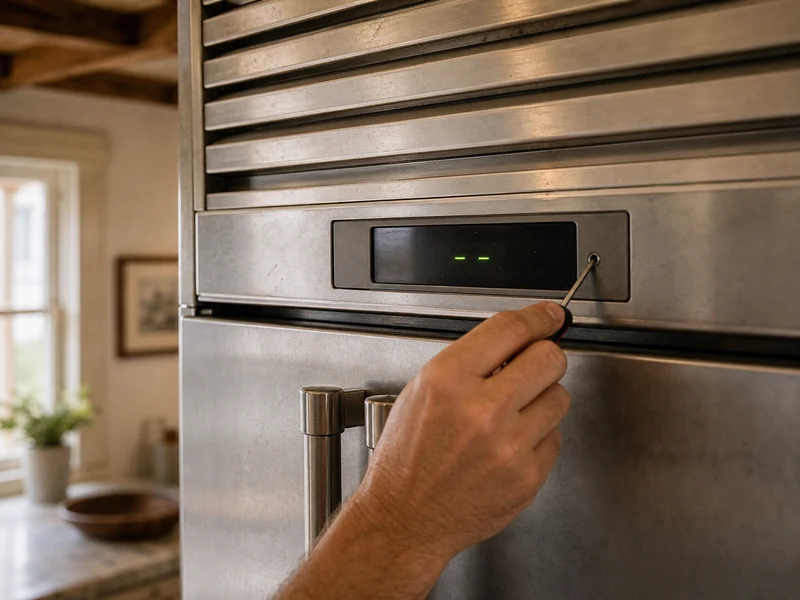
600 series symptom, first check, cost lane
This series fails in well-documented patterns. Find your symptom and you will know roughly where the visit lands before we ever pull a grille.
| What the unit is doing | Where we look first | Cost lane |
|---|---|---|
| Display showing two dashes | EEPROM control board — replace to serial | $550–$1,100 |
| "Vacuum Condenser" warning, long run times | Salt-coated condenser coil | $250–$550 |
| Service light on, temps off | Drifting thermistor (temp sensor) | $250–$550 |
| Ice maker dead, service light flashing | Solenoid energized past 15 seconds | $550–$1,100 |
| Fridge warm, freezer fine | Evaporator fan motor | $250–$550 |
| Cooling fading over weeks, partial frost stripe | Sealed-system / evaporator leak | $1,500–$3,000 |
House rule: the big sealed-system number only comes out after airflow, electrical, and pressure readings all line up. On a 600 the tell is a frost stripe covering just the first few inches of evaporator where a healthy coil wears an even coat — and that is something our triage page teaches you to spot.
Why parts knowledge is the whole game on this series
The 600 line is where guessing goes to die. Sub-Zero revised it relentlessly across thirteen years, so a 632 board, a 650 board, and a 661 board are not interchangeable, and even within one model the early and late revisions differ. A tech who orders by model name alone burns a trip and your week.
We do it the slow, correct way: model and serial off the tag inside the fresh-food door, every time, before a single part is ordered. That one habit is why most of these get fixed on the first visit instead of the third. Boards, thermistors, fan motors, and ice maker modules for this series still come available new or rebuilt, though the oldest revisions are thinning out — one more reason to identify the exact part up front.
When a board truly cannot be sourced, you get the straight version, not a stalled job. We lay out the repair-versus-replace math honestly, the same way we do on the deeper classics described under refrigerator repair.
The 600 roster, model by model
The line ran 1996 to 2009 in a handful of widths and configurations. Knowing which one you own narrows the failure pattern and the parts list before we ever arrive.
| Model | Width / type | Years |
|---|---|---|
| 611 | All-refrigerator or all-freezer column | 1996–2008 |
| 632 | 48" side-by-side | 1996–2008 |
| 642 | 42" side-by-side | 1996–2008 |
| 650 | 36" over-under | 1996–2008 |
| 661 | 36" bottom-freezer drawer | 2003–2008 |
| 690 | 48" side-by-side with dispenser | 1996–2004 |
| 685 / 695 | Later 48" variants | 2004–2008 |
Side-by-sides (632, 642, 690) hide their condenser up top behind the grille; over-unders and drawer units (650, 661) route airflow differently. That changes where salt collects and which fan motor wears first — one more reason the model number drives the diagnosis.
Three electronic generations, three diagnostic tells
The 600 series carried its electronics through three generations across thirteen years, and each behaves differently when it ages. Reading the symptom tells us roughly which generation board is in front of us before we pull the panel.
| Generation | Rough serial / years | Diagnostic tell |
|---|---|---|
| 600-1 | Below serial #1810000, late 1990s | Earliest boards, scarcest now — often rebuild-only |
| 600-2 | 1998–2002 boards | "Vacuum Condenser" warning on excessive run time |
| 600-3 | Later run to 2009 | Double-dash display when the EEPROM loses memory |
The double-dash readout is the headline failure: the board’s memory is gone, there is no reset, and it gets replaced to serial — but the refrigeration underneath is usually fine. The vacuum-condenser warning is gentler news; on the beach it almost always clears with a deep coil cleaning, not a part. Either way the partial-frost test on our not-cooling triage page separates a board problem from a real sealed-system leak.
Old classics, salt-air streets
The cottages between the ocean and East Coast Drive are full of these survivors, and the salt that rolls off Beach Avenue finds their condensers the same way it finds everything else here. A coil that cannot shed heat is exactly what trips the vacuum-condenser warning, which is why we put 600-series units close to the dune on the same quarterly cleaning rhythm laid out in our salt-air survival guide.
Educational diagnostic scenario
A 650 in a 1960s cottage two streets off the ocean: vacuum-condenser warning, compressor running for hours. Coil was packed with salt-bound dust; airflow nearly zero. Deep condenser cleaning, thermistor verified in spec, no parts needed beyond labor. Run times dropped back to normal within a day. The owner had been a phone call away from replacing a thirty-year-old unit that just needed its lungs cleared.
One town south, the same era of cottage holds the same era of unit, and we service them the same week — details on the Neptune Beach page. When the 600 has finally earned its retirement, the BI series is the built-in that took its place.
Repair-or-replace economics on a classic
These units were built for twenty-plus years, and the refrigeration usually outlives the electronics — which is what makes the math favor repair so often. Here is how the common 600-series calls actually pencil out at the beach.
| Situation | Repair cost | Verdict |
|---|---|---|
| Double-dash board, refrigeration sound | $550–$1,100 | Repair — board to serial, cabinet is fine |
| Vacuum-condenser warning | $250–$550 | Repair — usually a deep coil cleaning |
| Evaporator leak, otherwise solid | $1,500–$3,000 | Repair — vs. ~$14k once cabinetry is added |
| Board revision unsourceable | varies | Weigh it honestly — rebuilt board or replace |
| Rusted liner, seized hinges from salt | varies | Replace — the carcass is the problem |
We have seen evaporator-and-heat-exchanger jobs on thirty-year classics come in around $2,500 against five-figure replacement quotes. The one honest exception is a carcass salt has already eaten — and we say which case you have in writing. The same arithmetic for the built-ins that replaced this line is on the BI-series page.
Read your 600 before you call
This series talks in recognizable tells. Matching the symptom to the likely part narrows the visit and the part order before we arrive.
| What you see or hear | Likely part | First check |
|---|---|---|
| Two dashes on the display | EEPROM control board (600-3) | Confirm refrigeration still runs; order board to serial |
| "Vacuum Condenser" message | Salt-coated condenser coil | Pull the grille; deep-clean the fins |
| Service light, temps reading off | Drifting thermistor | Compare sensor reading to a calibrated reference |
| Ice maker dead, light flashing | Solenoid energized past 15 seconds | Test the module circuit, not just the valve |
| Partial frost stripe on the coil | Sealed-system / evaporator leak | Pressure test before any sealed-system quote |
The partial-frost test is the one worth learning yourself — a healthy coil wears an even white coat, while a leak frosts only the first few inches. Our not-cooling triage page walks through spotting it, and a frozen-floor defrost issue is covered on the freezer repair page.
Quick answers
600 series questions, answered straight
My 650 shows two dashes on the display — is it done?
The unit is not done; the control board is. A double-dash readout means the board’s EEPROM has lost its memory, and there is no reset for it — the board gets replaced. We match the part to your serial because the 600 line had three electronic generations and several revisions, so a board that fits a 632 may not fit your 650. The refrigeration underneath is usually fine.
Will a part off a 632 fit my 642 or 661?
Often not, and that is the trap with this series. Sub-Zero revised the 600 line constantly across its 1996 to 2009 run, so boards, fan motors, and ice maker modules carry model- and serial-specific differences. Guessing wrong burns a trip. We pull the exact model and serial off the door tag before ordering anything, which is why the first visit fixes most of these.
What is the "Vacuum Condenser" warning on an older 600?
It appears on 1998 to 2002 boards and means the compressor has been running too long — the board is telling you to clean the condenser. At the beach the cause is almost always salt-coated coil fins choking heat rejection. Nine times out of ten the fix starts with a thorough condenser cleaning, not a new part. If it persists, a thermistor or the board itself comes into question.
Is it worth fixing a thirty-year-old Sub-Zero classic?
Usually, yes. These were built for twenty-plus years and the cabinets often outlive two control boards. We have seen evaporator-and-heat-exchanger jobs on old classics land around $2,500 against replacement quotes starting near $14,000 once you add the cabinetry to fit a new box. The honest exception is a carcass salt has already eaten — rusted liners, seized hinges — and we will tell you which you have.
Are 600 series boards even available anymore?
Many still are, new or rebuilt, but the older revisions are getting scarce and some are rebuild-only now. That is one more reason we identify the exact board before promising a same-week fix. When a board genuinely cannot be sourced, we say so plainly and walk you through the repair-versus-replace math rather than stringing the job along.
How do I tell which electronic generation my 600 is — 600-1, 600-2, or 600-3?
The serial number does it. The earliest generation runs below serial #1810000; the later two come after, with running revisions inside each. You do not need to decode it yourself — read the full serial off the tag inside the fresh-food door and we cross-reference it, because that number determines which board, sensor, and ice-maker module actually fit. Ordering by model name alone is how the wrong part shows up.
Why does my 600-series freezer leak water onto the floor?
A clogged defrost drain, almost always. These classics have logged five thousand-plus defrost cycles, and the drain line gums up over the years until meltwater overflows the pan and runs out the bottom. Clearing the line and checking the drain heater that keeps it open is routine $250 to $550 work. It is one of the most common 600-series calls we get, and it is rarely the sign of anything worse.
Should I retrofit a modern Sub-Zero into my old 600-series cabinet opening?
Rarely worth it on a sound unit. A 600 opening was cut for a 600, and current Classic and Designer models have different dimensions, panel systems, and clearance needs, so a drop-in almost never drops in — you are into cabinetry work fast. As long as the refrigeration is healthy and boards are sourceable, keeping the classic running costs a fraction of a retrofit. We will give you the straight comparison before you commit either way.
My 600-series fridge is warm but the freezer is fine — what fails first on these?
The evaporator fan motor, most often. The 600 line shares more hardware between compartments than the later BI units, but the fresh-food side still leans on a fan to move cold across, and after fifteen-plus years that motor wears. A warm fridge with a healthy freezer usually means the fan, not the charge — a $250 to $550 fix. If the freezer is also drifting, then the compressor and sealed system come into the conversation.
Do salt-air streets shorten a 600-series unit’s life compared to inland?
They shorten the consumables, not the cabinet. The refrigeration on a 600 routinely outlasts two control boards regardless of location, but on Beach Avenue the condenser fouls faster, the gaskets harden in three to four years, and the vacuum-condenser warning shows up sooner. The fix is rhythm, not replacement — quarterly coil cleaning close to the dune keeps a thirty-year classic humming where neglect would retire it early.