Repairs
Sub-Zero Freezer Repair in Atlantic Beach
Frost where it shouldn’t be. Water where it really shouldn’t be. Both fixable, neither patient.
Sub-Zero Atlantic Beach repairs Sub-Zero freezers across Atlantic Beach and Neptune Beach, 32233 and 32266. Frost on the back wall or an ice sheet under the basket usually means a failed defrost part or a tired gasket — not a dying unit. Call (904) 650-0561 or book online; most freezer repairs land between $250 and $1,100.
For Sub-Zero repair in Atlantic Beach or Neptune Beach, call (904) 650-0561 or book online.
The three freezer complaints on this beach
Freezer calls here sort into three buckets, and each one starts the diagnosis in a different place.
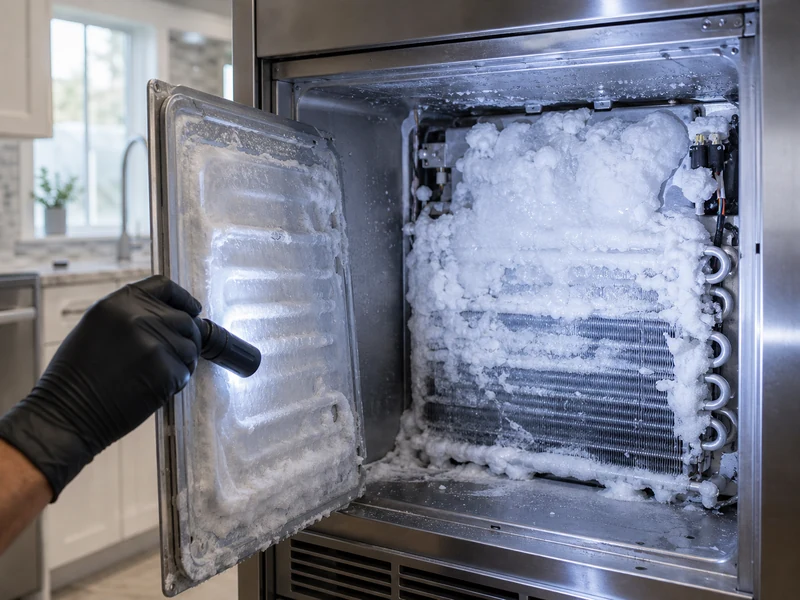
Frost coating the back wall
A fuzzy white coat that keeps coming back means moist air is getting in — and at the beach, the air is never anything but moist. The usual door is a hardened gasket; replacing the seal closes it. When the gasket checks out, the defrost system itself is suspect: a dead heater or thermostat lets the evaporator ice over until airflow chokes.
An ice sheet under the basket
Meltwater from every defrost cycle exits through a drain, and that drain clogs. The water pools, refreezes into a glacier under the bottom basket, and eventually escapes onto the floor. On classics that have logged five thousand-plus defrost cycles, this is less a malfunction than a scheduled appointment.
Freezer warm, refrigerator fine
On BI-generation units, the two compartments run separate sealed systems — the freezer side can fail alone. On older classics the same complaint points toward the compressor, the refrigerant charge, or a fan. Either way it is the most urgent of the three; start with the not-cooling checklist while you wait for us.
Complaint, cause, budget
| Complaint | Usual cause a block from the ocean | Budget |
|---|---|---|
| Fuzzy frost returning on the back wall | Gasket letting humid sea air in | $550–$1,100 |
| Ice sheet under the basket, wet floor | Clogged defrost drain | $250–$550 |
| Evaporator iced solid, weak airflow | Defrost heater or thermostat | $550–$1,100 |
| EC40 on the display | Excessive freezer-side run — coil first | $250–$550 |
| Freezer at 20°F, fridge normal (BI) | Freezer-side sealed system | $1,500–$3,000 |
| Door drifting open on its own | Hinge adjustment and gasket set | $550–$1,100 |
Humidity wins here unless you fight back
Atlantic Beach spends most of the year at swamp-grade humidity, and a nor’easter can park salt fog over Seminole Road for a week straight. Every door opening trades dry compartment air for wet beach air, and the freezer pays the exchange rate in frost.
The cottages between the ocean and East Coast Drive make it harder. Built-ins wedged into 1950s alcoves get starved airflow on the condenser side, so the whole machine runs hotter and longer — and out by Mayport, the salt rides further inland than anyone budgets for. The maintenance rhythm in our beach survival guide exists because of exactly this arithmetic.
One spec to hold onto: 0°F in the freezer, no colder. Cranking the dial down masks a failing system without fixing it, and costs you run time on a compressor that is already working overtime.
What a tech does on arrival for a freezer call
A freezer diagnosis is mostly about reading frost and airflow. The order rarely changes, and most of it happens before any part is named.
- Pull the rear evaporator panel and read the frost. An even white coat is normal; a solid ice block behind the panel says the defrost system quit. Frost only near the door points at a tired gasket instead.
- Test the defrost circuit cold. Defrost heater continuity and the bimetal thermostat get checked with a meter before either is condemned — a heater reads open when it has failed, and that is a $550 to $1,100 fix, not a sealed-system one.
- Check the drain and the pan. Warm water down the channel proves whether the line runs clear; a backed-up drain is the ice-sheet-and-wet-floor job in the $250 to $550 lane.
- Verify airflow and temperature. With the coil clear we confirm the evaporator fan moves air and the box pulls down to 0°F. Only if it will not, after the basics check out, do gauges come out for a sealed-system read.
Defrost failure or sealed system? How to tell
Two very different repairs hide behind the same complaint — a freezer that will not get cold. They cost wildly different money, so separating them early matters. The frost pattern usually gives it away before we touch a gauge.
| Clue | Points to defrost failure | Points to sealed system |
|---|---|---|
| Frost on the coil | Solid ice block over the whole evaporator | Frost on only the first few inches, then bare |
| How fast it warmed | Over days, after frost choked airflow | Slow fade over weeks |
| Air at the vents | Weak — the iced coil blocks it | Moving, but the air itself is not cold enough |
| What fixes it | Defrost heater or thermostat | Recover, repair leak, vacuum, recharge |
| Cost lane | $550–$1,100 | $1,500–$3,000 |
On a BI built-in the freezer runs its own sealed system, so a freezer-only failure does not touch the fridge side. On a 600-series classic the partial-frost stripe is the textbook evaporator-leak tell. Either way, we confirm with pressure readings before any sealed-system number leaves our mouths.
Parts that come off beach freezers most
The defrost system and the humidity drive nearly every freezer call here. These are the parts we replace most, why they fail on this coast, and where they sit.
| Part | Why it fails near the ocean | Where it lives |
|---|---|---|
| Defrost heater | Cycles for years until the element opens; ice then chokes the coil | Behind the rear evaporator panel |
| Defrost thermostat / bimetal | Loses calibration, leaving the heater stuck off | Clipped to the evaporator coil |
| Drain heater | Salt-grit and sludge clog the line it keeps open | At the defrost drain channel |
| Evaporator fan motor | Run hours plus frost drag wear the bearing | Freezer evaporator housing |
| Freezer door gasket | Salt fog and humidity harden it in 3–4 years | Both doors on paired and SxS units |
Drains, heaters, thermostats, and fan motors ride the van for BI and 600-series freezers by default. When the complaint traces to a tired seal instead, it starts with a proper gasket replacement — the most common root cause behind beach frost.
What you can try, and what wants a tech
A couple of freezer fixes are honest homeowner work. Past those, the tells overlap and a meter beats a guess.
Worth a careful try first
With the unit powered down, pour a cup of warm — not hot — water down the drain channel at the back floor of the freezer; if it runs through, the ice sheet was a one-time backup. Let a heavily iced coil thaw fully before judging whether frost returns. Confirm the door is closing flush and the gasket still grabs a dollar bill. None of that risks the unit.
Call when the frost keeps coming back
A drain that backs up no matter what, a coil that re-ices within days, an evaporator frozen into a solid block, or a freezer that will not hold 0°F all point at a defrost part or the sealed system — and those want continuity checks and gauges. Forcing a stiff wire down a drain risks puncturing the line, which turns a $250-to-$550 visit into a bigger one. The not-cooling triage page helps you tell which lane you are in.
Quick answers
Freezer questions, answered without the runaround
What makes an ice sheet form under the freezer basket?
A clogged defrost drain. Every defrost cycle melts frost off the evaporator, and that water needs a clear path out. When the drain gums up, meltwater pools in the floor of the compartment and refreezes into a sheet — then the overflow heads for your floors. Clearing the drain and checking the defrost parts that feed it usually lands in the $250 to $550 lane.
Is frost in a Sub-Zero freezer ever normal?
A light dusting near the door after a beach-house weekend of constant openings, sure — that clears on the next defrost cycle. What is never normal: a persistent fuzzy coat on the back wall, frost that returns within days, or buildup thick enough to catch the basket. Those mean humid air is getting in or the defrost system has quit, and both get worse on their own.
Can just the freezer side of a Sub-Zero fail?
On the BI generation, absolutely — refrigerator and freezer run on separate sealed systems, so one side can quit while the other hums along like nothing happened. On the older classics the compartments share more hardware, so a freezer problem there often points at the compressor, the charge, or airflow. Which design you own changes the whole diagnosis, which is why we ask for the model number first.
Do I need to empty the freezer before your visit?
No. Most freezer work — drains, heaters, thermostats, gaskets — happens with the food right where it is, and the compartment holds temperature fine for the duration. The exception is sealed-system work, which takes hours and warms the box; if your job heads that direction we will say so when we book it, not when we show up.
What does an EC40 code on the freezer side actually mean?
Excessive run time on the freezer compressor. On the beach the first suspect is the freezer-side condenser choked with salt-bound dust, so the system runs and runs trying to reject heat it cannot. A torn freezer gasket pulling in humid air does the same thing. We clear the airflow cause before condemning a part — an EC40 that traces to a dirty coil sits in the $250 to $550 lane, not the sealed-system one.
How do I clear a clogged Sub-Zero defrost drain myself?
Carefully, and only the easy version. With the unit powered down, pour a cup of warm — not hot — water down the drain channel at the back floor of the freezer and watch whether it runs through. If it backs up, ice or sludge is plugging the line and it needs to be cleared properly, sometimes with the drain heater checked. Forcing a stiff wire risks puncturing the line; that is where the $250 to $550 visit earns its keep.
Can a failed defrost heater make my whole freezer warm up?
Yes, indirectly. When the defrost heater quits, frost never gets cleared off the evaporator, so it ices into a solid block. That block strangles the airflow the fan needs to move cold around the compartment, and temperatures climb even though the compressor is working fine. The tell is a heavily frosted coil behind the rear panel with weak air at the vents — different from a sealed-system failure, which the <a href="/fix/not-cooling/">not-cooling triage page</a> helps you separate.
My freezer cycles loud, then quiet, in a rhythm — is that the defrost system?
Often, yes. A defrost timer or the adaptive defrost control kicking the heater on and off can make a freezer breathe in cycles, especially when the heater is straining against a heavy ice block. A grinding or scraping note instead points at the evaporator fan blade catching frost. We listen and meter the defrost circuit before naming a part, because a worn fan and a failing defrost control sound similar but cost differently.
How cold should a properly working Sub-Zero freezer actually run?
0°F, and no colder. That is the spec the food industry settles on and the number we verify before leaving every freezer call. Cranking the dial to -5 or -10 does not freeze faster; it just adds run time to a compressor that is already working overtime at this latitude, and it can mask a failing system. If your freezer cannot hold a steady 0°F, the fix is diagnosis — not a colder setting that hides the symptom.